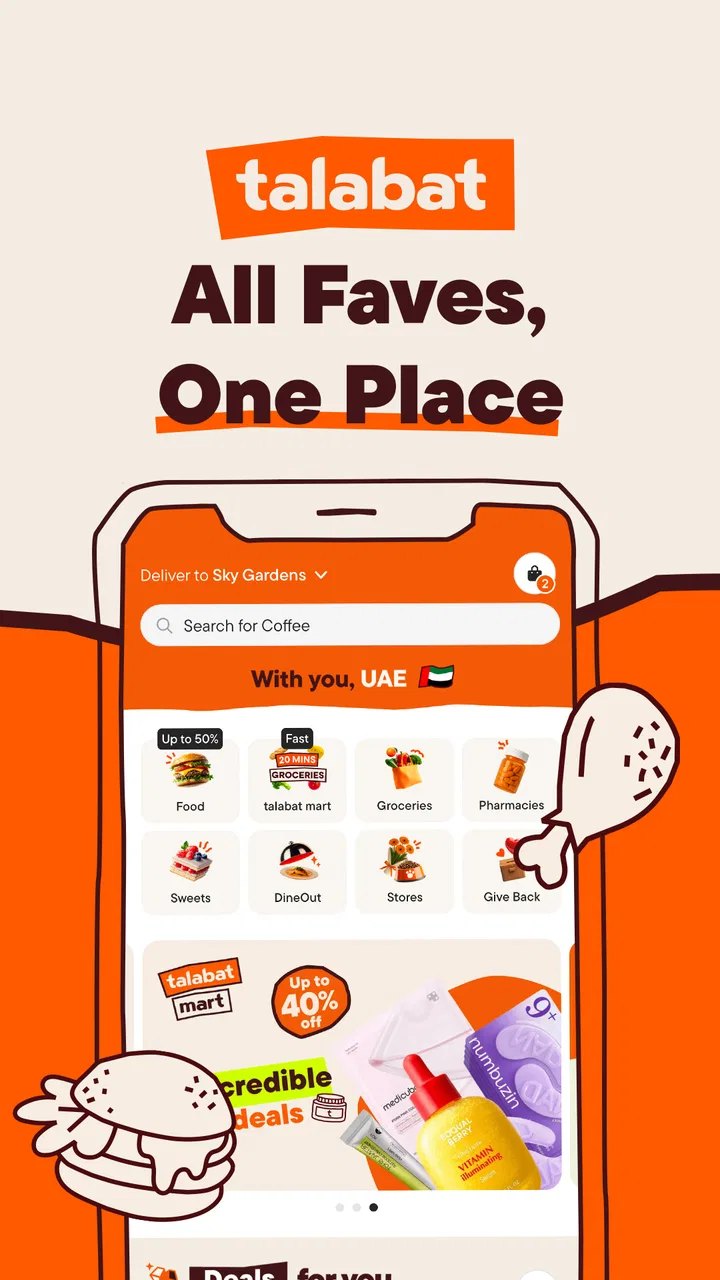
talabat: Food, grocery & more
- 4.3
- Rating
- 50.00M
- Installs
- Free
- Price

 Analysis by App-foxy
Ordering a meal after a long day sounds simple, but the experience often depends on how quickly I can find a suitable restaurant, understand the final cost, and keep track of the delivery without opening several different services. That is where talabat aims to help. It is a free Food & Drink app from Talabat that brings everyday food delivery together with grocery and other delivery choices in one place.
I approached it as the kind of app I would keep on my phone for ordinary situations rather than special occasions: a rushed weekday lunch, groceries needed before breakfast, or dinner when leaving home is inconvenient. Its store summary is “Everyday delivery, made easy,” and that description is brief, but it captures the main appeal reasonably well. The app is built around reducing the number of steps between deciding what I need and placing an order.
My overall impression is positive, with an important qualification: the value comes from convenience and local availability, not from assuming every order will be the cheapest option. If you already live in an area well covered by Talabat, the app can become a practical daily tool. If your preferred restaurants or shops are not represented, its usefulness drops quickly.
You May Also Like

 AccuWeather: Weather Radar
AccuWeather Review: A Quick, Clear Forecast for Everyday Decisions
For everyday plans, the best forecast is the one you can understand quickly. AccuWeather makes rain timing, radar, and local conditions easy to act on, with a few trade-offs.

 Hill Climb Racing
Why Hill Climb Racing Still Turns Crashes Into One More Run
A tiny car, a bumpy hill and one more upgrade: Hill Climb Racing keeps resurfacing because its simple chaos makes every near-miss feel personal.

 AliExpress - Shopping App
AliExpress Makes Global Shopping Feel Personal, but Shoppers Bear the Risk
AliExpress turns a global marketplace into a pocket-sized discovery engine. Its reach is useful, its shopping loop compelling, and its trade-offs easy to miss.

 Lords Mobile: Kingdom Wars
Lords Mobile Is a Kingdom-Building Routine, Not a Quick Match
A case-by-case verdict on the building, battles, device demands, and social commitments that make Lords Mobile rewarding for some players and exhausting for others.

 PDF Scanner app - TapScanner
TapScanner Makes Paperwork Easier to Capture, Check, and Share
TapScanner makes scanning with a phone feel less like a rescue operation and more like a dependable step in getting work done. Its capture tools are useful, though not flawless.

 Block Blast!
 Shows How Much a Puzzle Game Can Leave Out
A quiet grid game shows why puzzle players increasingly value instant clarity, repeatable skill and low-pressure play—and where the genre still needs to catch up.
More From Our News Desk
View All News


How talabat fits into everyday ordering
I find the most useful way to judge talabat is to start with the situation I’m trying to solve, rather than browsing without a plan. A quick meal, a few grocery essentials, and a larger household order call for different choices, even within the same app. That distinction helps me decide when its convenience is worth using and sets up a closer look at how the ordering experience fits into an ordinary day.
A broad delivery app rather than a single-purpose restaurant tool
Talabat is developed by Talabat and sits in the Food & Drink category, but its role is broader than a basic restaurant menu app. I see it as a central starting point for several kinds of delivery. That matters because the best service for a restaurant order is not always the best service for a few household items, and switching between separate apps can become irritating when I am trying to complete a simple task.
The app has been available since January 19, 2012, which gives it a long presence in the delivery space. Its scale is also substantial: it has passed ten million installs, with an average rating of 3.9 from around 485 thousand ratings and roughly 6.3 thousand written reviews. Those figures suggest that many people use it regularly, while the rating also tells me not to expect a flawless experience for every order or every location.
That local factor is essential. Delivery apps are not equally useful everywhere, even when the interface looks polished. A neighborhood with many participating restaurants and stores gives Talabat a much stronger advantage than an area with only a small selection. Before relying on it for a time-sensitive order, I would enter my delivery location and browse the actual choices rather than judging the service only by its general reputation.
What the free price really means
The app itself is free to download and use, so there is no purchase barrier to testing it. That is the clearest verified cost advantage: I can install it, inspect the available restaurants or grocery choices, and decide whether it suits my area without paying for access to the application.
That free access should not be confused with a guarantee that every delivery is free or that every order has the same final cost. The amount I pay for an order can depend on what I choose and how the order is presented at checkout. I would always check the complete total before confirming, especially when comparing a small order with pickup or with ordering directly from a restaurant.
This distinction is important when evaluating value. Talabat offers free access to its ordering platform, but the financial value of a particular purchase depends on the final order conditions visible during checkout. I would not install it expecting the app itself to make every meal inexpensive. I would install it because it may save time and make local delivery easier to manage.
The basic workflow I found most useful
My preferred workflow starts with the need, not with a restaurant name. If I want dinner, I browse by the type of food or the shops available nearby. If I need groceries, I look for the relevant delivery section instead of treating the app as only a takeaway directory. This approach makes the service more useful when I have not yet decided exactly where to order from.
Once I find an option, I review the menu or product selection carefully before adding items. I find this more reliable than filling a basket quickly and discovering later that the order does not match what I intended. For a shared meal, I also use the basket as a planning tool: I check quantities, side dishes, drinks, and substitutions before moving to the final review.
The most useful habit is to pause at checkout. I verify the address, the items, and the total before confirming. This small step prevents the common mistake of focusing on the advertised item price while overlooking the overall cost of the order. It also gives me a chance to remove an unnecessary add-on or change the order size when the basket no longer represents good value.
A realistic weekday example
Imagine I finish work late and have nothing ready for dinner. I open Talabat, enter my location, and compare the available options instead of messaging several restaurants individually. I can consider a prepared meal, look for a grocery order, or choose another available delivery option depending on what is listed nearby.
If I am ordering for one person, the main question is not simply which meal looks appealing. I need to decide whether the convenience justifies the total cost of a small basket. In that situation, I might choose a filling order with fewer extras, or combine the order with a household need if the available grocery selection makes that sensible. The app is most helpful when it reduces decision time without encouraging me to add items I did not originally need.
For a family or group, the calculation changes. A larger order can make delivery more practical because one person can organize everything in a single basket. I would still review the final amount and the expected timing, but the app’s central advantage becomes coordination rather than merely finding food.
Three less obvious ways to get more from it
First, I would use Talabat as a comparison screen before committing to my usual restaurant. Familiarity is convenient, but browsing nearby alternatives can reveal that another available option better matches the size of the order or the time of day. This is especially useful when I am flexible about cuisine and care more about a sensible total than about one specific venue.
Second, I would separate urgent orders from planning orders. For something needed immediately, I focus on nearby availability and a realistic delivery expectation. For groceries or a planned meal, I take more time to compare baskets and avoid impulse additions. Treating every order as urgent can lead to poor value, while treating every order as a shopping session can waste the convenience the app is meant to provide.
Third, I would use the app to decide whether delivery is actually the right option. If I am already near a restaurant, pickup or buying directly may be more economical. Talabat is strongest when the saved time, reduced travel, or wider access matters more than minimizing every possible cost. That is a genuine trade-off, not a flaw unique to this service.
Where the experience can become frustrating
The biggest limitation is that the app cannot solve a weak local selection. A large overall install base does not guarantee that my favorite restaurant, grocery store, or neighborhood is covered. If the available choices are limited, I may spend time browsing only to return to the same small group of options.
Another point of friction is the need to inspect the order carefully. A delivery platform makes ordering faster, but speed can encourage careless confirmation. I would not treat the first visible price as the final value judgment. The basket, delivery details, and total deserve a deliberate check, particularly for small orders where additional costs can change the decision.
There is also a practical difference between finding an option and having a satisfying order. The app can organize the process, but the quality of the food, the accuracy of the basket, and the delivery experience still depend on the selected provider and the circumstances of that order. I see Talabat as the layer that helps me choose and manage delivery, not as a promise that every participating business will perform identically.
Device support and who can start using it
The current version is 13.38.0, and the Android listing supports devices running Android 8.0 or later. That makes it accessible on many still-used Android phones, although anyone with an older device should check compatibility before planning around it.
The app is rated for Everyone, which fits its everyday ordering purpose. I would still expect parents to guide younger users around address details and payment decisions, since the age label describes suitability rather than removing the need for sensible supervision.
For a new user, the best first test is simple: install the free app, set the delivery location, browse a few categories, and inspect the basket without rushing to order. This quickly answers the questions that matter most in practice: whether the local selection is useful, whether the available choices fit the household, and whether the final cost feels reasonable.
Who is likely to get the most value?
Talabat is a strong fit for people who regularly order meals or groceries and want one familiar place to begin. It is particularly useful for busy workers, households coordinating a larger order, people who cannot easily travel to collect food, and anyone who values a broad delivery search more than contacting businesses one by one.
It can also help people who are new to an area. Rather than relying only on recommendations from friends, I can use the available listings to understand what delivery choices exist around me. That does not replace local knowledge, but it gives me a practical starting point when I need food quickly.
I would be more cautious if I mainly care about the lowest possible price, prefer collecting orders myself, or already have a direct relationship with a small number of restaurants. In those cases, ordering directly or using pickup may be a better choice. The free app is still easy to try, but free access alone does not make it the best purchasing route for every meal.
How it compares with the usual alternatives
Compared with calling a restaurant, Talabat is more convenient for browsing, organizing an order, and checking several choices in one session. A phone call can be better when I have a complicated request or need to speak directly with the business, but it is less efficient for comparing menus and building a shared basket.
Compared with ordering directly from a restaurant’s own service, Talabat may offer a wider starting point, especially when I have not decided where to eat. Direct ordering can be preferable when I already know the provider and want the simplest relationship with that business. I would compare the final totals rather than assuming either route is always cheaper.
Compared with a dedicated grocery service, Talabat’s broader delivery focus can be convenient when I want food and household items in the same general app experience. A specialist grocery option may be better for a large, carefully planned shop if it offers a more suitable range for my location. The right choice depends on whether I value variety across categories or depth within one category.
My final recommendation
I recommend trying talabat if delivery is part of your normal routine and the service has good coverage where you live. The app is free, available to a large Android audience, and useful as a single place to explore meals, groceries, and other delivery needs. Its strongest benefit is not a promise of the lowest bill; it is the time saved by bringing local choices into one ordering workflow.
I would skip it, or at least compare alternatives first, if you mostly use pickup, order from the same restaurant every time, or live in an area with limited listings. In those situations, a direct order or a local alternative may be simpler and better value.
My buying advice is therefore straightforward: install it without treating installation as a commitment, check what is genuinely available near you, and judge each order by its complete total rather than the headline item price. The best value comes from using the app selectively, not automatically. When I need convenience and local choice, it earns a place on my phone. When price minimization or direct contact matters more, I would use it as a comparison tool rather than my default.
FAQs for talabat: Food, grocery & more
01What services does talabat offer?
Talabat provides a comprehensive range of services including food delivery, grocery shopping, and other essentials. The app connects users with local restaurants, supermarkets, and various other service providers, ensuring a convenient and efficient way to meet everyday needs. It's a one-stop solution for quick and reliable service.
02Is talabat available in my region?
Talabat primarily operates in the Middle East and North Africa, serving countries like Kuwait, Saudi Arabia, the UAE, and others. It's best to check the app store or talabat's website to verify if the service is available in your specific location, as they are continually expanding their reach.
03How user-friendly is the talabat app?
The talabat app is designed with user-friendliness in mind. It features a clean interface and intuitive navigation, making it easy for users to search for restaurants, place orders, and track deliveries. Whether you're tech-savvy or not, you'll likely find the app easy to use and convenient.
04What payment methods does talabat accept?
Talabat offers multiple payment options to accommodate different user preferences. You can pay using credit or debit cards, and in certain regions, cash on delivery is also available. This flexibility ensures that users can choose the payment method that best suits their needs.
05Are there any additional fees when using talabat?
While using talabat, users might encounter additional fees such as delivery charges or service fees, which can vary based on the restaurant or service provider's policy. It's important to review the total cost at checkout to understand any extra charges before finalizing the order.
Pros
- Wide variety of restaurants available.
- User-friendly and intuitive interface.
- Real-time order tracking feature.
- Multiple payment options are supported.
- Frequent promotions and discounts.
Cons
- Occasional delivery delays reported.
- Some areas have limited restaurant options.
- Customer service can be inconsistent.
- Service fees can add up quickly.
- App can be slow during peak hours.

talabat: Food, grocery & more
Gallery